
Alliance Court Docket Searches
The Alliance Municipal Court Clerk sends docket search, e-file, and payment traffic through the shared Stark CJIS system. Pick AMC as the court. Then narrow the record to Civil, Criminal, or Traffic. Alliance court records sit beside every other participating court in one guest view. So a raw hit proves nothing about where the case belongs. Before trusting an entry, check the court code, case number, and category. All three must line up as an Alliance case.
Case detail on CJIS gives you a dated docket register. It also shows Case Status, Next Action, and categories that may hold charges or money items. Nothing identifies a file better than the Alliance case number. Without it, work the form's name and court controls as they exist today. A blank result can mean several things. It may be a wrong court filter, a spelling slip, or a category mismatch. It may also be a case that moved to the county docket, or a record closed to public access.
- Open the official CJIS route linked by the Alliance clerk and choose AMC.
- Select the Alliance case type printed on the record or citation.
- Search by Alliance case number when available, or use the live form’s name controls.
- Read the newest Alliance docket event with Case Status and Next Action.
- Contact the Alliance clerk with the case number for a setting or copy question.
Note: The CJIS guest view is a public docket layer only. A certified Alliance document stays a court record held by the clerk.
Alliance Municipal Court CJIS Docket
Alliance shares the CJIS gateway with the other Stark municipal courts. The AMC filter is what makes the search local. A basic field takes any search string you type, and the advanced form offers name, date of birth, case number, court, case type, phone, attorney-registration, and filing-date controls. Too many results? Narrow the query. The page itself governs which choices actually appear, so read the official Alliance form instead of trusting any unofficial lookup.
| Alliance CJIS field | Record value |
|---|---|
| AMC | Limits the shared query to Alliance Municipal Court. |
| Traffic, Criminal, Civil | Matches the Alliance case category to the filing. |
| Case Detail | Shows dated Alliance docket entries and current case labels. |
| Standard Public User | Is the published account and payment path, distinct from clerk copies. |
A docket text entry is not the filed paper itself. Guest PDF access can be limited. For a document or a certification, the Alliance clerk is the route.
Inside the Alliance Municipal Court
Alliance Municipal Court sits at 470 E. Market St., Room 16, Alliance, Ohio 44601. The main line is 330-823-6600. Per the court, its territory covers Alliance, Minerva, Robertsville, Limaville, and several listed townships. Misdemeanors are handled fully in Alliance. A felony stays only for the preliminary stage. It then moves to Common Pleas, so one incident can leave records in two courts. Weekday hours run roughly 8:30 a.m. to 4:30 p.m. Other listed contacts include civil fax 330-829-2231 and criminal and traffic fax 330-829-2230. The judge's office is 330-823-6181.
For hearing instructions, trust your notice and the live docket rather than an hours summary. When you call, give the case number and category. That lets the right office claim the record. The official Alliance Municipal Court Clerk site shows the court's local record route.
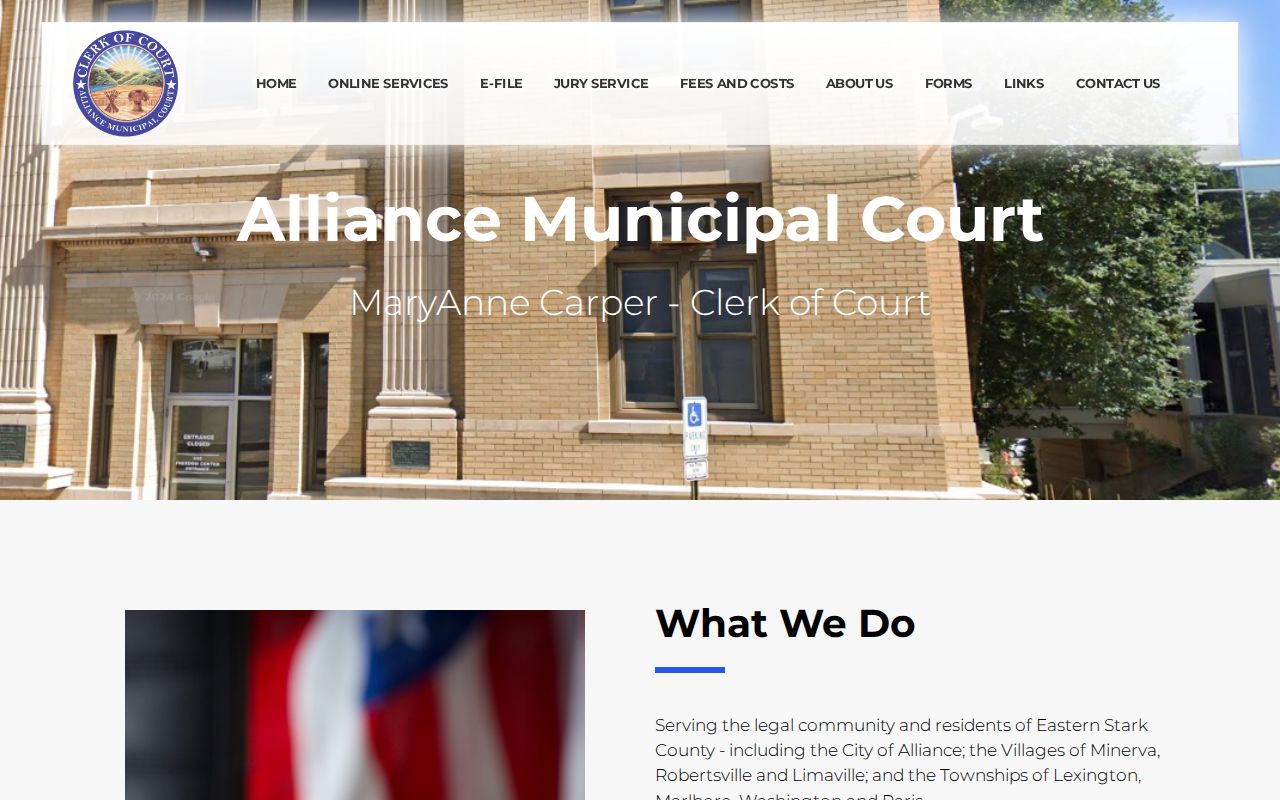
The lesson is simple. The Alliance clerk and the AMC-filtered CJIS docket are the two starting points for any Alliance municipal case.
Alliance Municipal Court
470 E. Market St., Room 16
Alliance, OH 44601
Main court line: 330-823-6600
Alliance Court Cases in 2025
Alliance Municipal Court logged 5,132 new cases in 2025 against 5,110 dispositions. The public report breaks that down. It lists 2,010 misdemeanor traffic matters, 910 misdemeanor criminal matters, 348 felony matters, 1,423 contract matters, and 31 small claims, with smaller categories beside them. Those counts explain why choosing AMC first matters before you open a case detail. Treat them as category totals, though. They say nothing about how long one Alliance docket takes. They say nothing about what any single record holds.
Alliance keeps its case categories and its financial reporting separate. Do not read receipts as case counts, and do not treat the totals as a live court calendar.
Note: The annual figures cover one reporting year, while the Alliance docket itself carries a case's current history and next action.
Finding Alliance Court Dates
Alliance court dates come from the freshest docket information. That information is confirmed with whichever office owns the case. CJIS case detail shows Case Status, Next Action, and dated docket entries. Read from the newest entry backward. Never assume a listed date is still live. A motion, a continuance ruling, a plea, or a disposition can reset the next event. When the record and your notice disagree, the hearing notice or direct court instruction wins.
| Date | The newest scheduled Alliance court date shown by the docket or notice. |
|---|---|
| Time | The stated Alliance hearing time, confirmed if there is doubt. |
| Courtroom | The Alliance location identified by the notice or court staff. |
| Judge | The assigned Alliance judicial officer or court displayed for the case. |
| Setting Type | An Alliance arraignment, hearing, trial, pretrial, or other docketed event. |
Alliance runs civil sessions on a Tuesday pattern and jury timing on Thursdays, but those routines never replace a case-specific setting. Have the case number handy when you call.
Alliance Traffic Arraignment Docket
Alliance traffic arraignments run at 1 p.m. on Monday, Wednesday, and Friday. The local rule sets that pattern. The Alliance Violations Bureau keeps weekday hours from 8:30 a.m. to 4:30 p.m. That schedule is a rhythm, not a promise. A traffic docket shows the charge, the next action, and any listed setting. It can never override the date printed on an Alliance citation. After any contact with the court, check the ticket again. Then read the newest docket entry.
- Arraignment
- An Alliance court appearance that addresses a traffic or criminal charge.
- Next Action
- The upcoming Alliance case activity shown on the case detail.
- Continuance
- A court-approved change to a previously scheduled Alliance event.
- Disposition
- The recorded Alliance outcome or procedural result.
A Massillon or Canton schedule means nothing for an Alliance court date. The territorial court and its own local rule set the Alliance session pattern.
Alliance Traffic Ticket Lookups
Start with the AMC CJIS path. You can also call the Alliance court office named on the citation. The direct traffic line is 330-823-6600 extension 110. The 2025 Alliance waiver schedule lists local examples. It also flags violations that require a court appearance. When a citation demands an appearance, the Alliance court process must handle it. Court material says the required appearance goes through the court. Time to pay can follow.
Alliance's published schedule covers examples like speeding and seat-belt violations. Confirm any current total with the court itself. For wider county traffic-record context, the Stark County traffic court page helps. For an Alliance arraignment, waiver, or continuation question, turn local. The local rule and docket remain the better sources.
Note: An appearance requirement marked on the citation controls the route. That holds even when the waiver schedule lists the violation.
Alliance Court Continuance Requests
Alliance court rules bar continuance requests by telephone. Moving an Alliance setting means following the court's stated process, and any additional continuance needs judicial approval. Plenty of people assume every municipal court handles schedule changes the same way. This one does not. A call or a left message changes nothing on its own.
After making a request, read the Alliance docket. The real signal is a later court entry or order naming the replacement action. If the newest entry stays unclear, call the main court line with the case number and ask staff to confirm the next date and time. Staff can confirm dates. They cannot give legal advice.
How Alliance Cases Reach the County
Alliance Municipal Court handles misdemeanors in full. A felony, though, may sit at the Alliance court only for a preliminary hearing before binding over to the Stark County Court of Common Pleas. From that point the record lives in a CPC criminal docket, with its own number, clerk path, dated filings, and court settings. So an Alliance preliminary result is never the complete record for a felony that has moved forward.
Docket flow: Alliance Municipal Court › Stark County Courts › Stark County Court of Common Pleas
The Stark County Clerk of Courts connects the public to the county CJIS route. That route covers Common Pleas work. Search AMC first for a local Alliance municipal record. Then search CPC after a felony bindover. Or search when the record itself names a Common Pleas case. The Stark County court docket home offers the wider court map.
Alliance Felony and Appeal Records
Three separate court records can follow one Alliance case. One is the felony preliminary docket. Another is a later Common Pleas docket, and a third is a Fifth District appeal docket. Appeals from Alliance Municipal Court go to the Fifth District Court of Appeals. Its Stark office sits at 110 Central Plaza South, Suite 320, Canton. The court line is 330-451-7765. A notice of appeal on an Alliance trial docket points to the next path. It does not reproduce the appellate filings.
The official PACER access material explains federal fee waivers. That channel is entirely separate from an Alliance municipal docket.
Federal PACER access replaces no AMC, CPC, or Fifth District search. Alliance court records stay with the Ohio court that owns the case.
Note: Alliance appellate filings carry a separate court record, so treat the municipal docket as the starting point rather than the full appeal.
Who Can See Alliance Court Records
Ohio's court-access framework presumes Alliance court records are open, but the presumption has limits. A remote docket display need not show every filing or attachment. Sealed matters may never appear as an ordinary Alliance public record. Protected personal identifiers and juvenile material are restricted in the same way. A no-result can also stem from the wrong court. Or it can stem from the wrong category, a misspelling, or a later county case. The responsible Alliance clerk can explain the record route, but cannot override a lawful restriction.
Key Rules:
Ohio Superintendence Rule 11.10 sets the presumption of public access to court records, subject to the rules and statutes.
Rules 11.11 through 11.14 address direct access, remote access, protected identifiers, and restrictions.
Ohio Revised Code 149.43 supplies the public-record framework for public offices.
An Alliance docket helps locate a case and trace its public chronology. It is not a tool for obtaining material the court lawfully restricts.
Alliance Clerk Copy Requests
Certified copies of an Alliance court record come from the Alliance clerk, not from the CJIS docket view. That online docket is handy, but it is not a certified document. A guest view also leaves some records hidden. A copy of one specific docket item has to be requested by hand. The Alliance fee schedule posted for 2025 prices certified copies at $3 each. Photocopies run $0.25 per page. Confirm those amounts before paying, since case type and current court procedure can change what a request costs.
When you ask the Alliance clerk for a docket item, name the case number, the court, and the exact document. Say whether you need certification too. That detail routes your request quickly. If a record is not visible through the public interface, the clerk counter beats a broad online search every time.
Be clear what kind of printout you want from the Alliance docket. Choices are the full chronological entry list, one filed item, or a certified copy. Fees and handling differ for each. Give staff the Alliance case number, the filing category, and the court's current location so nothing is guessed at. One caution is worth remembering. If a case later moved to Common Pleas or the Fifth District, that court holds the record. The request must go there instead.